Configure Email Printing
Last Updated: August 14, 2026
This topic explains how to configure Email Printing.
Requirements
Complete all the  general requirements.
Email Printing also requires the following:
- Configure the Lightweight Directory Access Protocol (LDAP) domain. For more details refer to LDAP Domain. Identity providers (IdPs) are not supported.
- Each user's email address must be stored as an attribute in the Active Directory (AD) user object.
Process Overview
You perform these high-level procedures:
- Configure the Service Agent.
- Connect the Email Account.
- Configure Attachment Settings.
- (Optional) Configure Public Key Infrastructure (PKI) Encryption.
- Confirm That the Email Printing Service Is Running.
- Configure Default Settings.
- (Optional) Configure Printer-Specific Settings.
1. Configure the Service Agent
Follow these steps:
- In the Admin Console, select the Service Agent.
- Select the Email Printing tab.
-
Select the checkbox for Enable Email Printing.

-
Select the None Selected button. Then browse and select a pull printer.

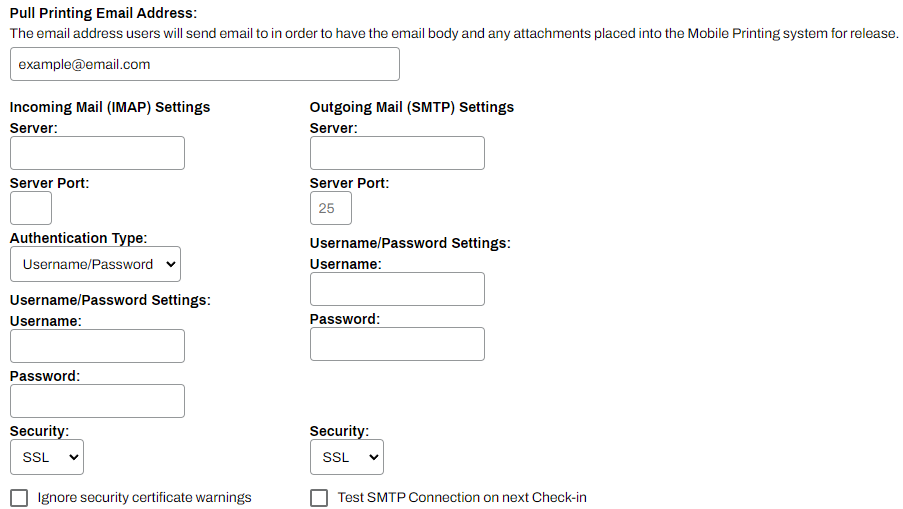
- In the Pull Printing Email Address field, assign an email address to the pull printer. This email is the address of the account created in the Requirements section above.
- In the Incoming Mail (IMAP) Settings section, complete the Server and Server Port fields.
- Complete the Authentication Type field depending on which email service you use.
- Configure the Outgoing Mail (SMTP) Settings:
- Complete the Server, Server Port, Username, and Password fields.
- From the Security dropdown menu, select from SSL, TLS, or None.
- Select the checkbox for Test SMTP Connection on next Check-in.
2. Connect the Email Account
The authentication type that you select for the Incoming Mail (IMAP) Settings depends on which authentication type your email service supports. For username / password configurations, follow the Username / Password Configuration steps below. For Office 365 and Microsoft Exchange configurations, follow the OAuth 2.0 Configuration steps below.
Username / Password Configuration
Follow these steps:
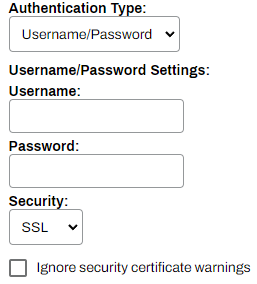
- From the Authentication Type menu, select Username/Password.
- Enter the email account's username and password in their respective fields.
- From the Security menu, select from SSL, TLS, or None.
- (Optional) Select the Ignore security certificate warnings checkbox.
OAuth 2.0 Configuration
Configure OAuth 2.0 in the Entra ID (Azure AD) portal before completing the steps below. If you are not the Entra ID admin for your organization, do the following:
- Send the admin the link to Configure Open Authorization (OAuth) 2.0.
- The steps in the 4. Collect Application & Directory IDs section explain where to find the application and directory IDs that you need.
- Define the email to use, which is used in step two below. The email must have access to Entra ID. You need to log in using that email in step eight below.
After configuring OAuth in Entra ID and collecting the IDs, follow these steps:
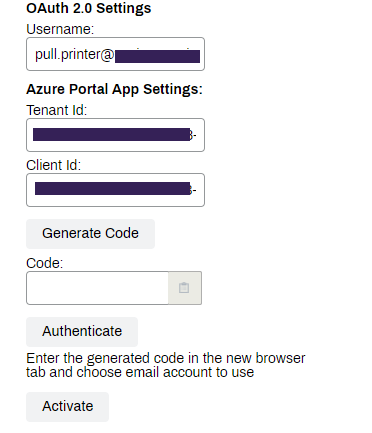
- From the Authentication Type menu, select OAuth 2.0
- In the OAuth 2.0 Settings section, enter an email address with access to the Entra ID portal in the Username field.
- Copy the Entra ID Directory (tenant) ID, and paste it in the Admin Console Tenant Id field.
- Copy the Entra ID Application (client) ID, and paste it in the Admin Console Client Id field.
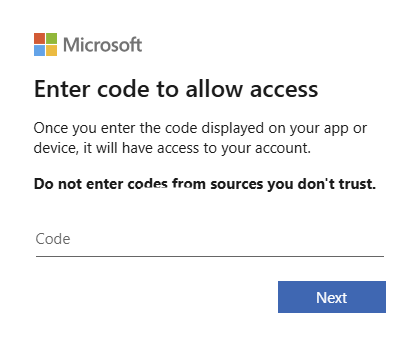
- Select the Generate Code button, and copy the provided code.
- Select the Authenticate button.
-
In the Microsoft window, paste the code, and then select Next.
- Sign in with the same account that is connected to the email you entered in the Username field.
- Select the Consent on behalf of your organization checkbox, and then select Accept.
-
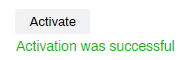
In the Admin Console below the Activate button, confirm that activation succeeded, and then select Save.
3. Configure Attachment Settings
The supported formats for printing email attachments depends on whether you have LibreOffice installed on your server.
Without LibreOffice Installed
With LibreOffice Installed
The following steps guide you through configuring Email Printing with attachments:
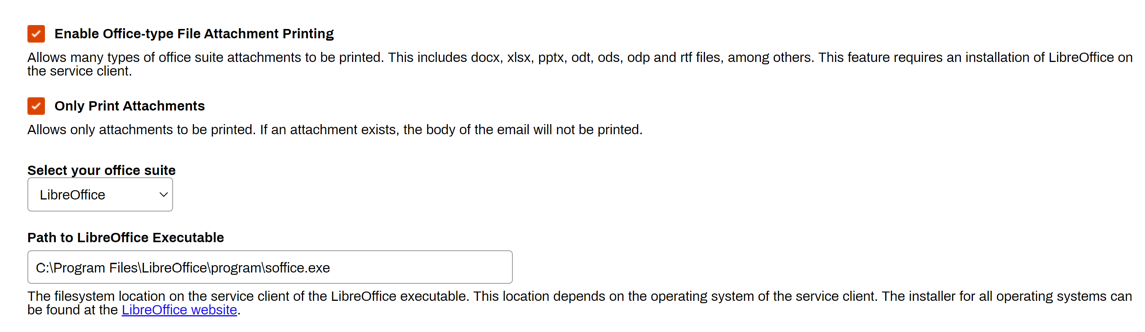
- Select the checkbox for Enable Office-type File Attachment Printing.
- (Optional) Select Only Print Attachments. This option ignores the email body and prints only files that are attached to the email.
- Leave LibreOffice selected in the Select your office suite field.
- In the Path to LibreOffice Executable field, enter the path to the executable file. For example, C:\Program Files\LibreOffice.
- Select Save.
4. (Optional) Configure PKI Encryption
The last section on the Service Agent's Email Printing tab is for PKI encryption. Follow the steps below if you want to configure PKI encryption for Email Printing in your environment.
PKI Encryption
Install Win32 OpenSSL v3.2.2 on the Windows Service Agent device:
- On the Service Agent device, go to https://slproweb.com/products/Win32OpenSSL.html.
- Select the EXE link to download the file.
- Run the downloaded file, and complete the installation process.
- Add OpenSSL to the Path variable:
- Select the Windows Start menu, and type "path."
- Select Edit the system environment variables.
- On the Advanced tab, select the Environment Variables button.
- In the System variables section, select Path, and then select Edit.
- Select Edit in the window.
- Double-click the next available empty line, and enter the path to the OpenSSL bin folder. For example, C:\Program Files (x86)\OpenSSL-Win32\bin.
- Select OK.
- After you install OpenSSL, restart the device.
- After the device restarts, go to the Service Agent's Email Printing tab in the Admin Console.
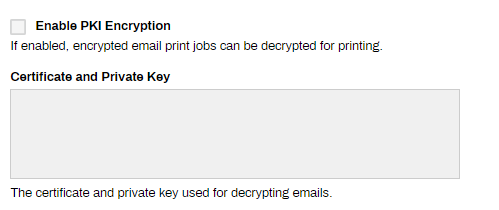
- Select the Enable PKI Encryption checkbox.
-
Copy the certification key, and paste it in the Certificate and Private Key field.
- Select Save.
- Restart the Service Agent.
5. Confirm That the Email Printing Service Is Running
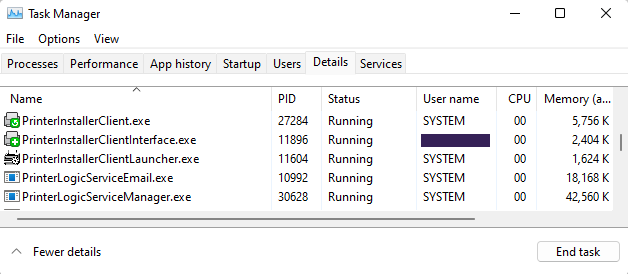
After saving the Email Printing configurations, confirm that the PrinterLogicServiceEmail.exe service is running. The steps below explain how to check the service on a Windows Service Agent device:
- On the Service Agent device, open the Task Manager.
- Select the Processes or Details tab.
- Search for "printer."
- Confirm that the following services are running:
- The three Vasion Agent services: PrinterInstallerClient.exe, PrinterInstallerClientInterface.exe, and PrinterInstallerClientLauncher.exe.
- The Service Agent's PrinterLogicServiceManager.exe service.
- The Email Printing's PrinterLogicServiceEmail.exe service.
Services for other active features on the Service Agent object also appear.
6. Configure Default Settings
The following settings help you customize the Email Printing user experience. In the Admin Console, go to Tools  Settings Printing, and scroll down to the Email Pull Printing section.
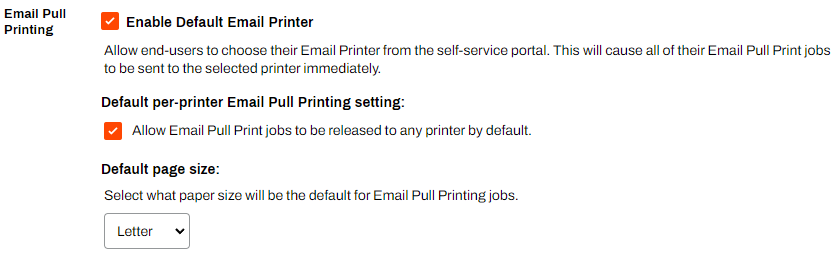
Here is an overview of the settings:
- Enable Default Email Printer
- Select the checkbox to show the Set Email Pull Printer option in the Self-service Portal. This option lets the end user set a default printer to automatically release their Email Printing jobs.
- Default per-printer Email Pull Printing setting
- Select the checkbox to allow the selection of any printer to release Email Printing jobs, using the default settings.
- Default page size
- Select the default paper size to use for Email Printing. Available options include Letter, Legal, Tabloid, Index, and A1 through A8.
Select Save in the upper-right corner after configuring these settings.
7. (Optional) Configure Printer-Specific Settings
If you turn on the Default per-printer Email Pull Printing setting at the global level, you can control which printers are available for Email Printing using the printer's Printing tab. Follow the steps below to configure the settings for a printer object:
- Select the printer object's Printing tab.
- In the Email Pull Printing section, select Use printer-specific Email Pull Print setting.
-
Select the checkbox for Allow Email Pull Print jobs to be released to this printer. This printer can be configured as a user's Email Printer.

- Select Save.
- Repeat as needed for additional printer objects.
Only printers with this setting turned on are available as release printers for Email Printing.
In this topic: