Identity Management
Last Updated: September 08, 2026
When you connect an identity provider, Vasion assigns a unique identity to uniquely identify an individual who accesses the application.
Identities authenticate through multiple methods:
- Local: Created manually within Vasion Automate Fed or PrinterLogic.
- IdP: Managed through third-party identity services like Okta, Entra ID (Azure AD), Google Identity, etc.
The unified login experience allows identities to be recognized across both PrinterLogic and Vasion Automate Fed.
Vasion cannot remove provisioned users from a customer's database for security and compliance reasons. There are a few options admins can use to remove users individually or in bulk from their instance. Details on both methods are included below.
Individual Users
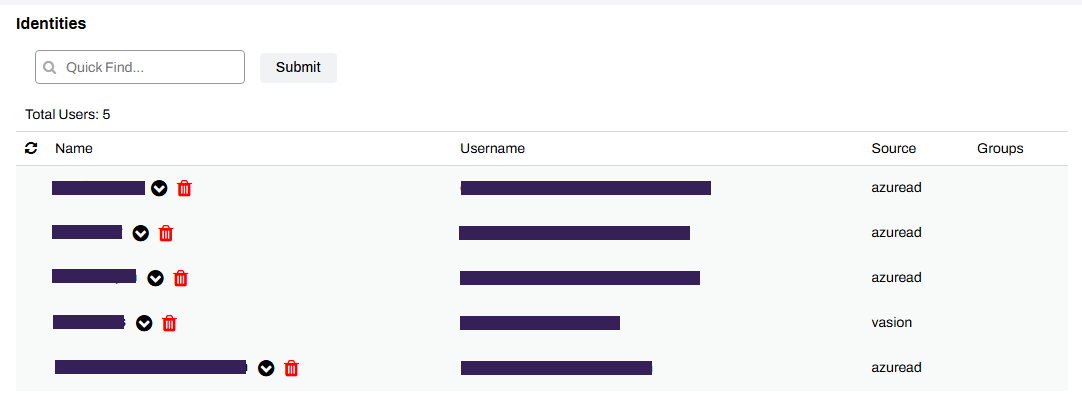
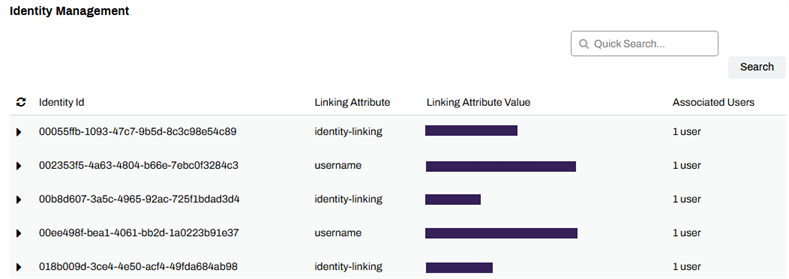
The access to the users individual identities depends on how your instance is configured. An instance with a single IdP configured displays the Identities screen, while an instance configured with multiple IdPs displays the Identity Management screen.
To access the identities go to
Tools  Identities, or Tools Identity Management depending on your instance setup.
On either screen you can use the Search button  to enable the field you can use to filter users by name or username.
Identities
Identities displays the following user details in a table format:
- Name
- Displays the user's name as defined by the First Name and Last Name fields in the IdP or local user record.
- Username
- Displays the username, which is defined by the IdP or local user record.
- Source
- Displays the IdP source, such as Entra ID, Okta, etc. If the user was added manually as a local user the source displays vasion.
- Groups
- Displays group associations for the user as assigned in the IdP.
Identity Management
The screen displays the following for each user in a table:
- User ID
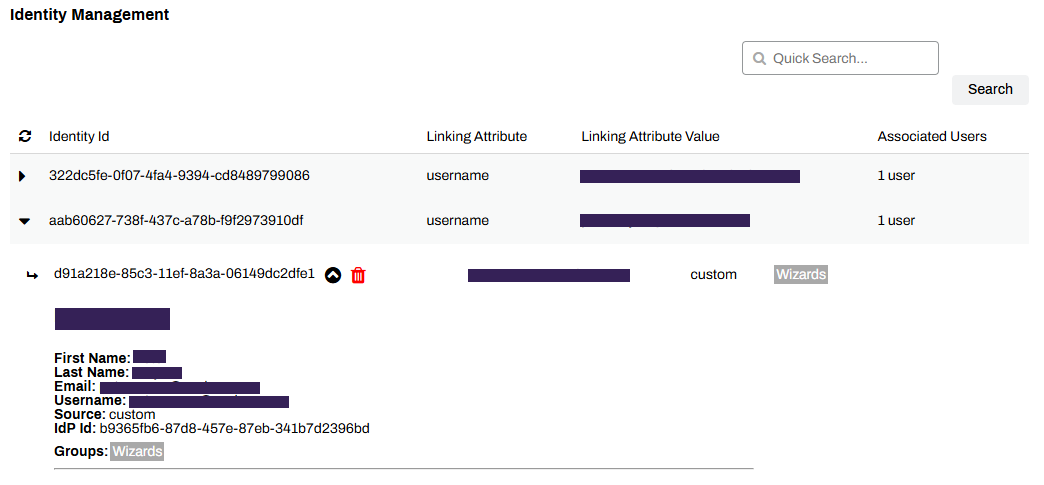
- Unique number assigned to the user by the IdP. A user provisioned from multiple IdPs has multiple User IDs associated with their Identity ID. Expanding the User ID displays user information that is specific to the fields configured in the IdP. For example, First Name, Last Name, Email, Manager, etc.
- Linking Attribute
- Identifies which attribute (username, email, etc.) in the IdP creates the association with the Identity ID.
- Linking Attribute Value
- Attribute value used to link multiple User IDs to a common Identity ID.
- Associated Users
- Number of User IDs associated with the Identity ID.
Delete Individual Users
You can use the Identities and Identity Management tabs to delete individual users from your database. This action only removes users from the instance database and not from your IdP. Do the following to delete a user from your database:
- Access the option in your instance by going to Tools Identities or Tools Identity Management.
- Search for the desired user, and expand the Name or Identity ID.
- Select the Trash Can button
 .
. -
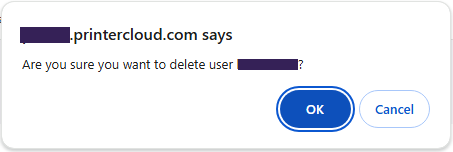
Select OK in the modal.
IdP Users
There are three actions for bulk IdP user management:
- Deactivate All Users
- This action deactivates all users for the selected IdP. Restart the sync to enable the users again.
- Delete Provisioned Data
- This action deletes all IdP users and groups from the database for the selected IdP. This action also removes all RBAC, portal security, and printer deployment rule associations for the users and groups; they must be provisioned again to be available for use.
- Delete IdP Groups
- This action deletes all IdP groups from the database for the selected IdP. This action also removes all RBAC, portal security, and printer deployment rule associations for the groups; they must be provisioned again to be available for use.
- Navigate to Tools
 Settings General in the Admin Console.
 - In the Identity Provider Settings section, select SCIM.
- From the dropdown menu, select the desired IdP.
- Select the button for the desired action.
- Follow the Proceed and Delete prompts in the modal.

In this topic: